
• Home
  • News
  • Workpackages
  • Links
  • Contact
    • ACCIONA
    • AZVI
    • BMR
    • CEMEX
    • Community of Madrid
    • CWare
    • DONG Energy
    • GRANAR
    • TEMECAL
    • TRL
    • WUT
  • Home
  • News
  • Workpackages
  • Links
  • Contact
    • ACCIONA
    • AZVI
    • BMR
    • CEMEX
    • Community of Madrid
    • CWare
    • DONG Energy
    • GRANAR
    • TEMECAL
    • TRL
    • WUT
APSE on YouTube ⇦ Click here

Publication: Thermal and Fatigue Evaluation of Asphalt Mixtures Containing RAP Treated with a Bio-Agent

Browse: Home / 2017 / February
27Feb2017

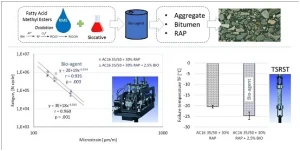
Publication: Thermal and Fatigue Evaluation of Asphalt Mixtures Containing RAP Treated with a Bio-Agent

by Andrzej Długołęcki in News

Kowalski K. J., Król J. B., Bańkowski W., Radziszewski P., Sarnowski M., Thermal and Fatigue Evaluation of Asphalt Mixtures Containing RAP Treated with a Bio-Agent,  Applied Sciences, vol. 7, no. 3: 216, 2017.

Special issue: Advanced Asphalt Materials and Paving Technologies.

DOI: 10.3390/app7030216

Abstract

Environment conservation and diminishing natural resources caused an increase in popularity of the application of renewable bio-origin resources for the construction of road pavement. Currently, there are known additions of bio-origin materials for bitumen modification. Such material is also used as a flux additive for bitumen or as a rejuvenator once working with reclaimed asphalt pavement (RAP). This paper presents research dealing with asphalt mixtures with RAP modified with a bio-agent of rapeseed origin. The main idea of the conducted research was to apply more RAP content directly to the batch mix plant without extra RAP heating. The RAP used in this study was milled from a base asphalt layer; the addition of RAP stiffens new asphalt mixtures. A bio-agent, due to its fluxing action, was used to support the asphalt mixing process and to decrease the over-stiffening of the mixture caused by RAP addition. This research includes bitumen and mixture tests. For the bitumen study, three different bitumens (35/50, 50/70, and 70/100) were tested in a dynamic shear rheometer (DSR) for complex modulus G* and for phase angle |δ| in the temperature range 0–100 °C. The reference mixture and mixtures with 2.5% bio-agent were tested to assess the influence of RAP and the bio-agent addition on the asphalt mixture properties. Low temperature behavior (TSRST), stiffness, and fatigue resistance (4PB) were tested. Based on the bitumen test, it was determined that even a low rate of bio-agent (2.5%) beneficially changes bitumen properties at a low temperature; moreover, polymerization processes occurring in the second stage of the process improves bitumen properties at a high operational temperature. The research with these asphalt mixtures demonstrates that the bio-origin flux acts as a rejuvenator and allows for an application of 30% cold RAP. Thermal cracking resistance of the mixture with RAP and 2.5% bio-agent improved. The bio-agent removes unfavorable stiffening of RAP and increases the fatigue resistance of the asphalt mixture. View Full-Text

PDF http://www.mdpi.com/2076-3417/7/3/216/pdf

Keywords: bioadditive; reclaim asphalt pavement (RAP); warm mix asphalt (WMA); sustainable roads
13Feb2017

SETAC Europe

by Birgitte Holt Andersen in News

The abstract on Life Cycle Costing Analysis of the innovative asphalt pavement has been accepted for a poster type presentation at  SETAC Europe 27th Annual Meeting in Brussels (7 – 11 May, 2017).

10Feb2017

GREEN ingredients reduce the cost of asphalt paving by up to 24% in the APSE road paving concept

by Birgitte Holt Andersen in News

By using residuals such as lignin (a by-product of bioethanol production), construction and demolition waste (C&DW) and reclaimed asphalt (RAP) the costs of new road pavings can be reduced considerably: from 17% in Spain, 22% in Poland and 24% in the UK.

Lignin substitutes up to 10% of the bitumen used in the surface layer. The application of 2.5-5% of bio flux agent allows usage of up to 30% reclaimed asphalt pavement (RAP) in base and binder layers, 100% substitution of virgin aggregates with construction and demolition waste leads to a reduction in consumption of natural aggregates. The results indicate that 1 m2 of APSE pavement requires 58-66% less natural aggregates, comparing to the conventional pavement.

The application of the lignin modified bitumen in the surface layers allows to reduce costs by up to 5.6%, compared to the conventional pavement. In total, the cost-effectiveness of flexible APSE pavement in construction stage is the following: in Spain it is 9%, whereas in Poland it is 22% and in the UK it is 24%. The cost-effectiveness of semi-rigid APSE pavement is estimated to be 17% in Spain and 22% in the UK and Poland.

03Feb2017

FEBRUARY – TRL and CWare month

by Andrzej Długołęcki in News
February 2017
M T W T F S S
« Jan   Mar »
 12345
6789101112
13141516171819
20212223242526
2728  

Login Status

You are not logged in.

Twitter

APSE PROJECT
ACCIONA https://t.co/aMIfxSFCQf
over a year ago

This project has received funding from the EUROPEAN UNION’S SEVENTH PROGRAMME for research, technological development and demonstration under grant agreement No 603862.